
750 tons of Iranian military weapons discovered in the Red Sea! How will the geopolitical storm stir up the gold market after the Houthi armed supply line is cut off?
- July 18, 2025
- Posted by: Macro Global Markets
- Category: News

1、 Iranian arms ship intercepted: The ‘powder keg’ of the Middle East situation ignited
On July 17, 2025, during a patrol mission in the Red Sea, Yemeni security forces intercepted a cargo ship flying the Liberian flag, carrying 750 tons of weapons that caused a global shock. According to the on-site video and list released by the Yemeni authorities, this batch of weapons includes advanced equipment such as naval missile systems, air defense radars, attack drones, and anti armor missiles. Some of the weapons’ Persian language manuals and Iranian Ministry of Defense affiliated enterprise logos directly point to their sources. Tariq Saleh, a member of the Yemeni Presidential Leadership Council, explicitly stated in a statement that these weapons are “starting from Iran and aimed directly at the Houthi armed forces”, and emphasized that their tactical value far exceeds the needs of the Yemeni civil war, implying that they may be used in broader regional conflicts.
Iran immediately denied any connection to the incident, with Foreign Ministry spokesperson Nasser Kanani stating on social media that the allegations were “political manipulation by Western countries” and emphasizing that Iran “has never provided military assistance to any non-state actors”. However, the international community is not convinced by this: the US Central Command has called the interception a “key operation to contain regional conflicts,” the EU Foreign Affairs spokesperson has stated that they will “re evaluate sanctions against Iran,” and Saudi Arabia has announced increased military patrols in the Red Sea. Even more ironic is that the drone components seized in Yemen are highly similar to key components of the Iranian “Eyewitness 136” drone, which was previously used by Houthi militants to attack Israeli targets.
2、 Geopolitical risk escalation: Red Sea shipping paralysis and global supply chain turbulence
This weapon interception incident directly impacted the lifeline of Red Sea shipping. As of July 18th, the daily traffic volume of the Suez Canal has dropped to 25 ships, a decrease of 32% compared to before the crisis. Osama Rabie, Chairman of the Suez Canal Authority in Egypt, confirmed that the canal’s revenue for the 2023/2024 fiscal year sharply decreased by 23.4% year-on-year to $7.2 billion, while the figure for the 2022/2023 fiscal year was $9.4 billion. Shipping giants Maersk Line and Mediterranean Shipping have announced an indefinite suspension of the Red Sea route, with 90 container ships diverted to the Cape of Good Hope in Africa, resulting in a 10-15 day extension of transportation cycles from Asia to Europe and a surge in logistics costs. The war risk premium in the London insurance market has soared to 5% of the ship’s value, reaching a new high since 2008. A container ship passing through the Red Sea needs to pay an additional $450000 premium, which is equivalent to the cost of 20 modified drones for the Houthis.
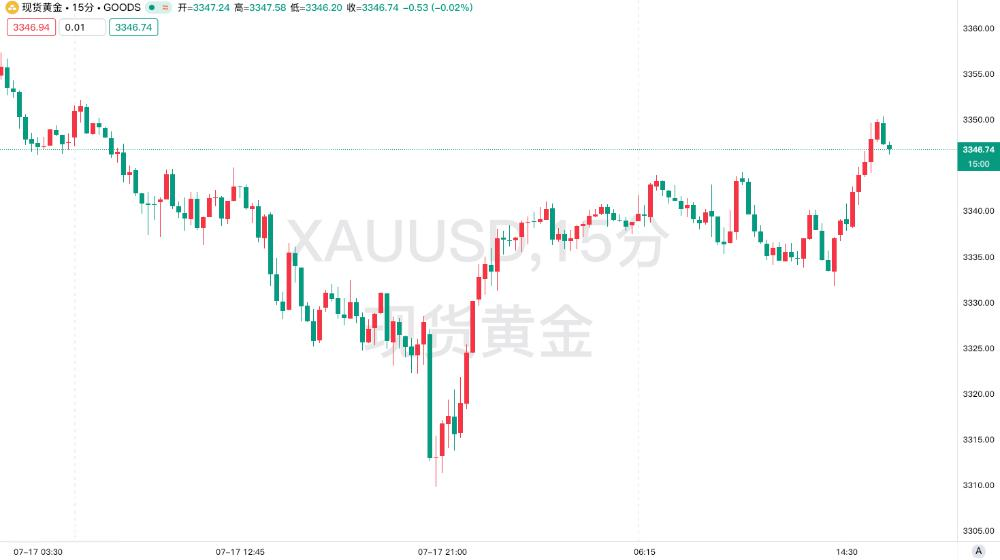
The spillover effects of geopolitical risks quickly spread to financial markets. On the morning of July 18th in the Asian market, London gold opened at $3338.5 per ounce, with a fluctuation range of $3333.9-3344 per ounce. It is currently at $3346.87 per ounce, a slight increase of 0.25%. On a technical level, the price of gold oscillates within the range of $3335-3345, with the daily average still in a wide range of $3320-3350. The 50 day moving average and 200 day moving average form a clamp range of $3325-3340, and the Bollinger Bands middle track at $3335 becomes a short-term long short watershed.
3、 Market Game Focus: Iran’s Strategic Contraction and Increased US Sanctions
Iran’s attitude in this incident is intriguing. On the one hand, the authorities deny any involvement in the transportation of weapons and emphasize that they have never supported regional conflicts; On the other hand, there has been no substantial rebuttal to the allegations made by the Yemeni government, nor has any evidence been provided to prove the third-party possibility of the source of the weapons. This vague tactic of “neither acknowledging nor clarifying” is considered by analysts to be Iran’s strategic contraction in the US Iran game – avoiding triggering a new round of US sanctions while unwilling to completely cut off ties with the Houthis.
The United States takes the opportunity to increase pressure on Iran. On July 18th, the US Treasury Department announced new sanctions against 18 individuals and entities in Iran, citing their “support for Iran’s ballistic missile program and transnational crime,” marking another move after the Houthis were reclassified as a “terrorist organization” in June. The Pentagon also announced that it will strengthen military patrols in the Red Sea and consider establishing an “escort alliance” with allies to ensure waterway safety. The analysis points out that this move by the United States is not only a deterrent to Iran, but also a pretext for possible military intervention in the future.
In this era of deep geopolitical and financial market interdependence, the value of gold as a “crisis currency” is once again highlighted. The 750 ton weapons in the Red Sea are not only clear evidence of Iran’s relationship with the Houthis, but also a microcosm of the chaos in the Middle East.




 English
  Chinese
  Vietnamese