
Lightning raid! Israeli army seizes air superiority in western Iran within 48 hours, leading to a surge in demand for gold as a safe haven
- June 17, 2025
- Posted by: Macro Global Markets
- Category: News
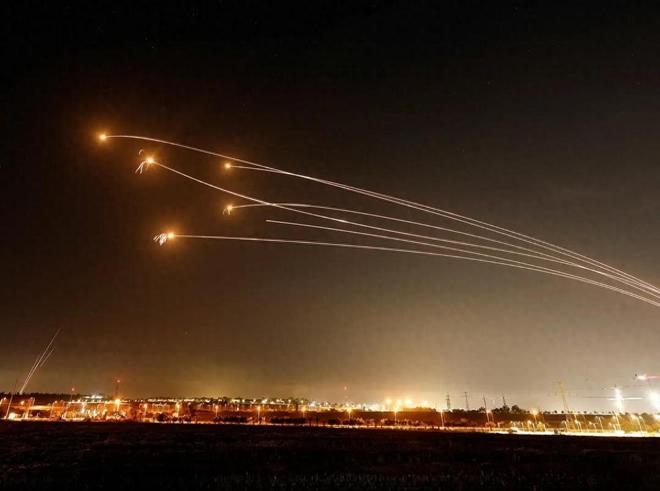
1、 Military action: Precision air strikes and breakthroughs in air superiority
The Israeli military had previously destroyed over 40 key targets within Iran, including the Natanz nuclear facility, missile factory, and Tehran Revolutionary Guard headquarters. Iran’s air defense system was paralyzed in the first round of strikes, and Israeli fighter jets subsequently penetrated deep into Iran’s hinterland, operating continuously over Tehran for 2.5 hours, completely gaining air superiority from western Iran to the capital.
As of June 16th, the Israeli military has carried out continuous airstrikes for over 50 hours, hitting more than 150 targets, including strategic facilities such as the Isfahan Nuclear Power Plant and the Karaj Nuclear Science Center. Although Iran launched nearly 200 ballistic missiles and drones in retaliation, most of them were intercepted by Israel’s “Iron Dome” system, causing only limited losses. Israeli Prime Minister Netanyahu stated in a statement on the 15th that the operation will continue for several weeks until the Iranian nuclear threat is completely eliminated.
2、 Geopolitical Pattern: US Israel Collaboration and Regional Chain Reaction
This operation is a continuation of Israel’s “preemptive” strategy against Iran’s nuclear program. Since Iran launched 180 missiles at Israel in October 2024, the conflict between the two sides has continued to escalate. Israel’s operation has been tacitly approved by the United States, which not only assisted in intercepting Iranian missiles but also reallocated Middle Eastern military resources to support the Israeli military. White House officials revealed that the Trump administration is “aware of and secretly supports” Israel’s long-term strike plan, but if Iran attacks American targets, it will provoke “unprecedented retaliation”.
Regional reactions show differentiation: Gulf countries such as Saudi Arabia and the United Arab Emirates remain silent, while Russia condemns Israel’s “military aggression” and calls for resolving disputes through dialogue. Iran’s Supreme Leader Ayatollah Khamenei has vowed to “completely destroy the Israeli regime” and threatened to block the Strait of Hormuz, which carries 40% of the world’s oil transportation. If blocked, it would cause severe fluctuations in the energy market.
3、 Gold Market: Resonance between Risk Avoidance Wave and Policy Game
Driven by geopolitical risks, the price of gold surged to $3450.98 per ounce in the Asian session on June 16th, reaching a historic high and rising more than 3.4% from the low on June 12th.
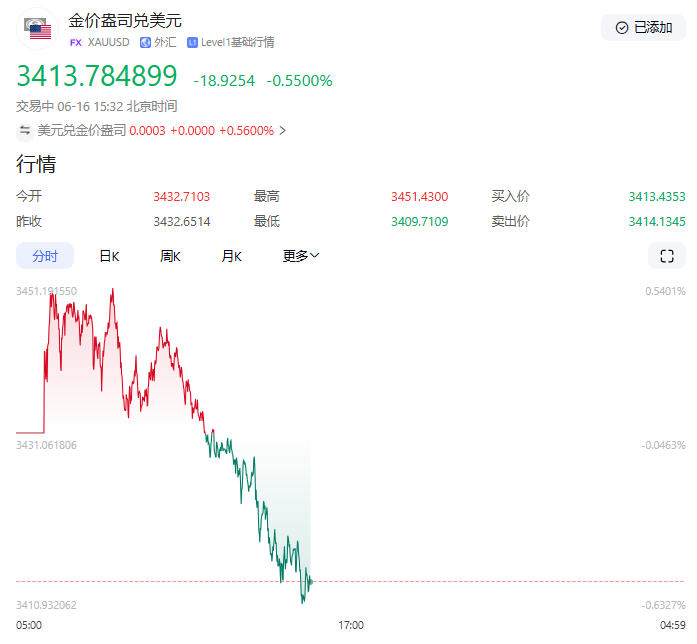
Analysis of core driving factors:
Geopolitical hedging dominates short-term volatility: Israel’s precise strike on Iran’s nuclear facilities has raised concerns in the market about the escalation of the conflict. Historical data shows that when the Iran conflict escalated in April 2024, gold prices jumped 1% in a single day to $2370; In this incident, the gold safe haven premium has once again become prominent, and short-term funds have accelerated their inflow.
Federal Reserve policy expectations diverge: Although the US CPI in May was expected to be 2.4% year-on-year, the transmission effect of tariffs may delay the decline of inflation, and the market’s expectation of a Fed rate cut in September has risen to 76.3%. If the dovish signal is released at the interest rate meeting on June 19th, gold is expected to break through the resistance level of $3472; On the contrary, if the Federal Reserve strengthens its hawkish stance, gold prices may fall back to the support level of $3400.
Central bank gold purchases and de dollarization support: In the first quarter of 2025, global central banks increased their holdings of gold by 244 tons, and China increased its gold reserves to 73.83 million ounces for seven consecutive months. Gold has surpassed the euro to become the world’s second largest reserve asset. This structural demand provides long-term support for gold prices.
4、 Institutional perspective
UBS predicts that if the situation in the Middle East continues to deteriorate, the target price for gold this year may reach $3500, with geopolitical risks and expectations of interest rate cuts forming a “dual drive”.
Everbright Futures pointed out that if Iran blocks the Strait of Hormuz, oil prices may soar to $250 per barrel, and the anti inflation properties of gold will be strengthened simultaneously.
Israel’s lightning strike on Iran has rewritten the military balance in the Middle East. Investors need to be alert to the risk of a pullback after the situation eases, while closely monitoring the Federal Reserve’s interest rate meeting and Iran’s countermeasures. Against the backdrop of “de dollarization” and global economic slowdown, the strategic allocation value of gold has become increasingly prominent.



 English
  Chinese
  Vietnamese