
March Interest Rate Report: The Federal Reserve maintains interest rates unchanged and hints at a rate cut
- March 21, 2025
- Posted by: Macro Global Markets
- Category: News
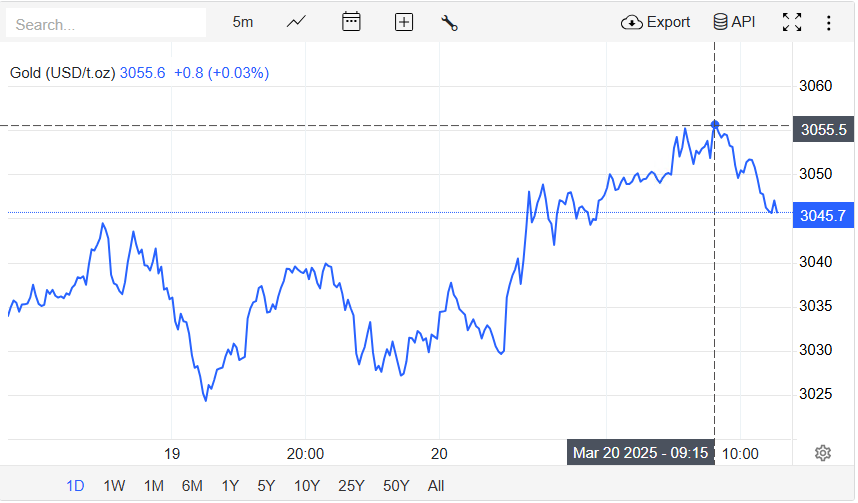
On the early morning of March 20th, the Federal Reserve announced that it would keep the benchmark interest rate unchanged in the range of 4.25% -4.5%, and hinted that it may cut interest rates twice this year. This decision is in line with market expectations, but the economic forecast released after the meeting and Powell’s statement still caused market volatility. Affected by this, the spot gold price surged to a record high of $3055.6 per ounce in the short term, while the US dollar index fell under pressure.
1、 Economic expectations lowered and inflation concerns coexist
The Federal Reserve has significantly lowered its 2025 GDP growth forecast from 2.1% to 1.7% in its latest quarterly economic outlook, while raising its core PCE inflation forecast from 2.5% to 2.8%. This adjustment reflects the dual concerns of policy makers about slowing economic growth and rising inflationary pressures. The dot plot shows that 9 out of 19 officials support cutting interest rates twice this year, 4 believe in cutting interest rates once, and 2 lean towards three cuts, indicating that internal differences in policy paths have widened.

Federal Reserve Chairman Powell emphasized at a press conference that the current economic situation is highly uncertain, and tariff policies and geopolitical conflicts may exacerbate the risk of stagflation. He said that if the labor market unexpectedly weakens or inflation continues to fall, the Federal Reserve will consider cutting interest rates; But if inflationary pressures persist, policies may maintain a restrictive stance. It is worth noting that Powell mentioned for the first time a “technical” slowdown in the balance sheet reduction plan, lowering the upper limit of US bond holdings from $25 billion to $5 billion starting from April, and maintaining MBS holdings at $35 billion per month. This measure has been interpreted by the market as implicit easing.
2、 Institutional viewpoint: dovish signals and divergence coexist
Zheshang Securities pointed out that Powell referred to the inflation caused by tariffs as “transient” in this meeting, which was seen as a dovish signal. The bank believes that although the dot plot shows two interest rate cuts within the year, the actual number of cuts may depend on whether the impact of tariff policies is short-term. China International Capital Corporation (CICC) stated that the Federal Reserve maintains its expectation of interest rate cuts unchanged, indicating that its concerns about economic downturn risks outweigh inflationary pressures, and expects the next interest rate cut to be in the third quarter.
Huatai Securities analyzed that the Fed’s decision to cut interest rates will depend on Trump’s policies and economic data from March to April. If the growth momentum rapidly declines, there may be a mid year interest rate cut; If the economy is not in recession, the rate cut may not exceed two times within the year. CITIC Securities reminds that under the current combination of “temporary inflation+growth slowdown+high uncertainty”, the number of interest rate cuts may be less than expected, and we need to be vigilant about the possibility of further market disruptions caused by tariff policies.
3、 Market reaction: Gold hits new high, US dollar weakens
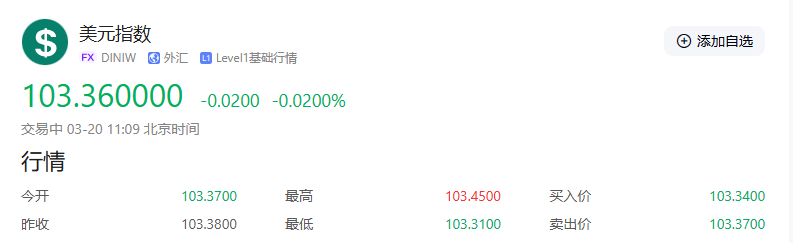
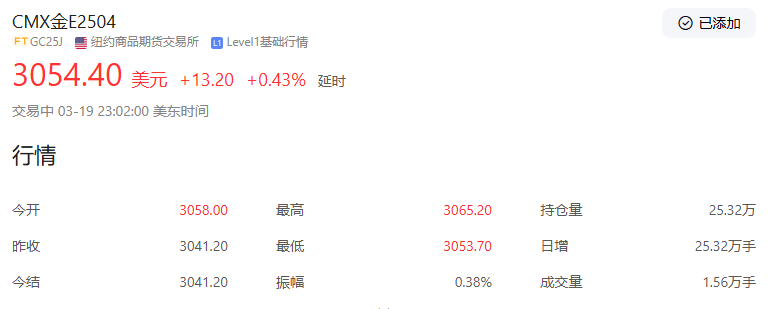
After the announcement of the resolution, the three major US stock indexes surged in the short term, with the Nasdaq rising more than 2% at one point, and the technology and precious metal sectors performing well. Spot gold continued its upward trend, with COMEX gold futures closing up 0.43% at $3054.4 per ounce, while silver fell slightly after fluctuating at a high level. The US dollar index fell under pressure, and US bond yields fell across the board. The 2-year US bond yield fell 6.96 basis points to 3.9681%, and the 10-year yield fell below the 4.25% mark.
The analysis points out that the Federal Reserve’s pessimistic expectations for economic growth and the upward adjustment of inflation pressure further strengthen the safe haven nature of gold. At the same time, the slowdown in the pace of balance sheet contraction and the release of liquidity expectations also provide support for gold prices. However, some institutions remind that although the current gold ETF holdings have rebounded, speculative long positions have reached historical highs and caution should be taken against profit taking risks.
4、 Future outlook: Policy path depends on data and tariff trends
The market’s pricing for the Federal Reserve’s interest rate cut has been reflected in interest rate futures in advance. CME data shows that the probability of a rate cut in June has risen to 62.1%, but there is still a probability of over 80% that interest rates will remain unchanged in May. Institutions generally believe that the future policy direction will depend on the actual impact of inflation data and tariff policies. If tariffs push up core inflation and economic data remains weak, the Federal Reserve may be forced to accelerate the pace of interest rate cuts; On the contrary, if inflation falls more than expected, the pace of interest rate cuts may slow down.
For the precious metal market, short-term domestic margin risks and loose expectations will still dominate the gold price trend, while silver may experience increased volatility due to its strong industrial properties. Investors need to closely monitor the upcoming US first quarter GDP data in April and the details of the Trump administration’s tariff policies to grasp market direction.
The Federal Reserve’s decision sends a cautious dovish signal, but the policy path still remains highly uncertain. Against the backdrop of the interweaving of tariffs and geopolitical risks, the value of gold as a safe haven asset is highlighted, but caution should be exercised against the short-term downside risks brought about by market sentiment fluctuations. In the future, data-driven and policy trends will become key variables affecting gold and silver prices, and investors need to closely monitor these changes.



 English
  Chinese
  Vietnamese