
The EU’s dual track system counterattacks Trump’s tariff war: zero tariff negotiations and countermeasures are launched simultaneously, and the gold market faces another risk aversion test
- April 9, 2025
- Posted by: Macro Global Markets
- Category: News

1、 The EU has officially launched a dual track strategy of “negotiation+countermeasures”, targeting the threat of US tariffs
On April 8th Beijing time, the European Commission announced at an emergency meeting of trade ministers in Luxembourg that it will adopt a dual track response strategy of “soft and hard” to the Trump administration’s “equal tariffs” policy: on the one hand, it will propose a “zero to zero” car tariff agreement for negotiations, and on the other hand, it will finalize the first batch of countermeasures timetable, demonstrating the game logic of “promoting negotiations with peace and ending the war with war”.
Negotiation priority: extend the olive branch of “zero tariffs”
EU Trade Commissioner Shevchenko stated that the EU has proposed a “zero tariffs, zero barriers, and zero subsidies” trade agreement for automobiles and industrial products to the United States, aimed at avoiding the world’s two largest economies from falling into a full-scale tariff war. The proposal was pushed by German car companies and covers EU advantageous industries such as automobiles, machinery, and chemicals, but was publicly refuted by US trade advisors, who claimed that it “ignores the core demands of the US manufacturing industry”.
Countermeasures ready: phased launch of € 26 billion tariff retaliation
The EU has made it clear that it will not wait indefinitely for the outcome of negotiations, and announced that countermeasures will be implemented in two steps: on April 15th, the first batch of precise tariffs will be launched, targeting US steel, agricultural products, whiskey and other commodities worth about 12 billion euros; May 15th: Implement the second batch of countermeasures, expanding to include technology products, aviation components, etc., with a total scale controlled at 26 billion euros.
In addition, the EU retains the “Anti Coercive Instrument (ACI)” as the ultimate option, which may restrict US companies from participating in EU public procurement and impose digital taxes on US digital service giants.
2、 The escalation of the transatlantic trade war has heightened market panic
The 25% car tariff and 20% global tariff implemented by the Trump administration on April 6th have led to a surge in export costs for the European Union to the United States. Data shows that in March, the export value of automobiles from the 27 EU countries to the United States decreased by 18% compared to the previous month, and the export volume of steel plummeted by 22%. French Finance Minister Le Maire warned, “If the United States refuses to negotiate, EU countermeasures will severely damage the manufacturing industries of both sides, and the global supply chain may face a ‘second rupture’
Immediate market response:
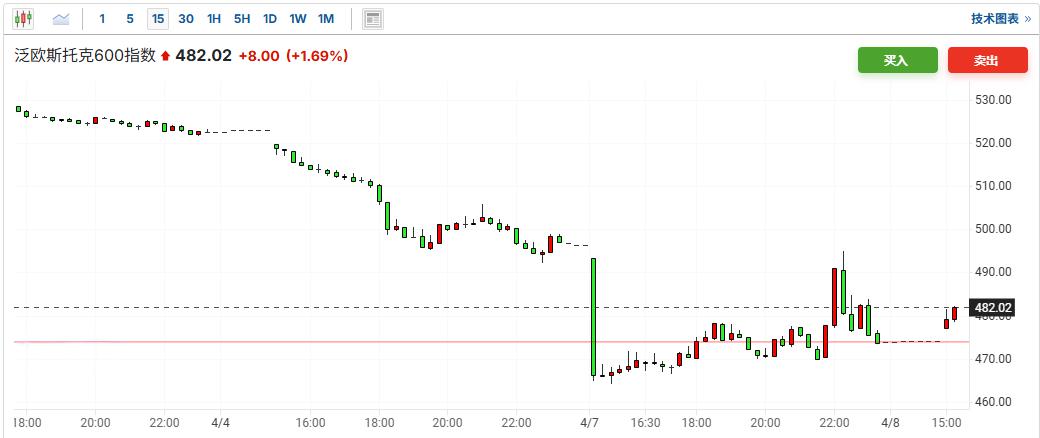
European stock market crash: The pan European Stoxx 600 index fell 4.13% on Monday, while the German DAX index plummeted 7.83%, hitting a new low since October 2023.
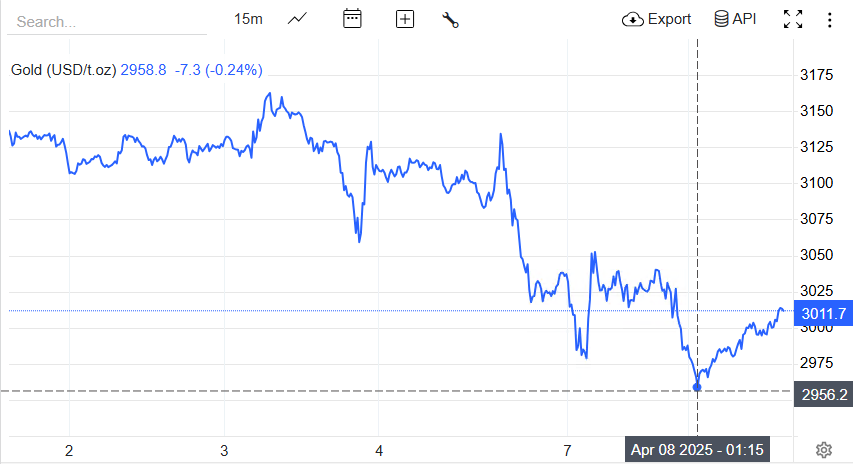
Differentiation of gold hedging attributes: Spot gold fell below $2960 per ounce in early trading, hitting a new low in several days, as investors sold gold to cope with stock market margin calls. However, in the afternoon, as panic spread, gold prices rebounded to around $3010, indicating market divergence on the risk of “stagflation”.
3、 The impact of long short games on the gold market
The EU’s dual track strategy has intensified short-term volatility in the gold market, but medium – to long-term safe haven demand remains supported
Short term bearish factors: The demand for safe haven in the US dollar diverted funds, and the tariff war led to a sharp decline in market risk appetite. The US dollar index climbed to 103.50, reaching a new high in nearly a month, and the attractiveness of gold denominated in US dollars to non US investors decreased.
Medium and long-term profit logic: geopolitical risk premium has increased, the escalation of trade frictions between Europe and the United States has formed a “risk resonance” with the Russia-Ukraine conflict and the situation in the Middle East, and the allocation demand for gold as the ultimate hedging asset has increased.
4、 Risk Warning
Sudden change in negotiation progress: If the “zero tariff” negotiations between the United States and Europe are unexpectedly reached, a rebound in market risk appetite may lead to a short-term pullback in gold;
Upgraded countermeasures: If the EU uses “anti coercion tools” to strike US tech giants, it may trigger a sharp decline in US stocks and exacerbate gold liquidity risks; The Federal Reserve’s policy shift: Tariffs have led to higher than expected inflation in the United States, and the Fed may delay interest rate cuts, with rising real interest rates suppressing gold valuations.
The EU’s dual track strategy marks a new stage of “playing and talking” in the transatlantic trade game, and the gold market is facing a critical choice between short-term liquidity pressure and medium – to long-term safe haven demand. Investors need to closely monitor the effectiveness of the first batch of EU countermeasures implemented on April 15th and the ministerial level negotiations on European and American trade on April 24th.

 English
  Chinese
  Vietnamese