
The Federal Reserve has kept interest rates unchanged for five consecutive months, and expectations of interest rate cuts have cooled down! Under the pressure of tariffs and inflation, Powell sends signals of flexible policies
- June 20, 2025
- Posted by: Macro Global Markets
- Category: News
1、 Federal Reserve Policy Resolution: Hold Still and Expected Revision
On the early morning of June 19th Beijing time, the Federal Open Market Committee (FOMC) of the Federal Reserve announced that it would keep the federal funds rate unchanged in the range of 4.25% -4.50%, marking the fifth consecutive pause in interest rate hikes since December 2024, in line with market expectations. The resolution statement pointed out that the US economic activity is “steadily expanding” and the unemployment rate is “staying low”, but at the same time emphasized that inflation is “still slightly high”, and for the first time mentioned the “impact of net export fluctuations on data”, implying that the Federal Reserve is wary of the transmission effect of tariff policies and external risks.
The divergence of the dot plot intensifies, and the expectation of interest rate cuts cools down
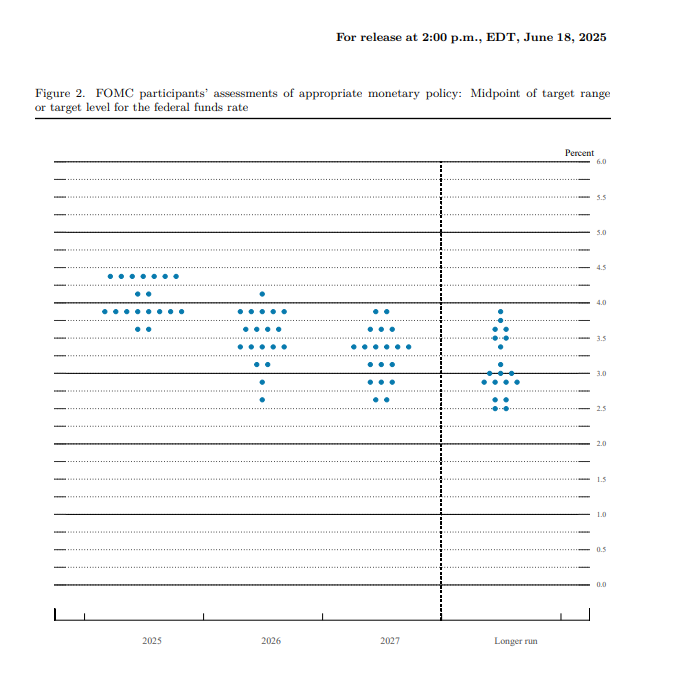
The latest dot matrix chart shows a significant divergence in the internal opinions of the Federal Reserve on the path of interest rate cuts in 2025: among 19 officials, 7 believe that there is no need to cut interest rates (4 in March), 10 support two interest rate cuts, 2 support one interest rate cut, and the median expectation is still to maintain two interest rate cuts (cumulative 50 basis points), but more conservative than the March meeting. It is worth noting that the expectation of interest rate cuts in 2026 has been reduced from four in March to one, and the final value of long-term interest rates has been raised to 3.1%, highlighting the Federal Reserve’s concerns about the “longer high interest rate” scenario.
Economic forecast raises inflation and lowers growth expectations
The Federal Reserve has significantly revised its economic outlook in the Summary of Economic Forecasts (SEP): it has lowered its 2025 GDP growth forecast from 1.7% in March to 1.4%, raised its core PCE inflation forecast from 2.8% to 3.1%, and raised its unemployment rate forecast from 4.4% to 4.5%. Powell bluntly stated at a press conference that tariff policies may lead to a “significant increase” in inflation pressure this summer, and consumers will inevitably bear some of the costs, while the Federal Reserve needs to wait for more data to verify the inflation transmission path.
2、 Policy Logic: Balancing Anti Inflation and Anti Recession Difficulties
1. Tariff shock and inflation stickiness
The large-scale tariff policy implemented by the Trump administration since April 2025, involving imported goods worth over $500 billion, is reshaping inflation expectations. Powell pointed out that although the current inflation data is moderate, the lagging impact of tariffs on the supply chain will gradually become apparent in June and July, especially in areas such as electronics and industrial equipment where there have been signs of price increases. The Federal Reserve predicts that the core PCE inflation rate will rise to 3.1% in 2025, which is 1 percentage point higher than the current level, forcing policymakers to postpone interest rate cuts to avoid inflation expectations becoming anchored.
2. Data dependence and flexible response
Powell repeatedly emphasized the principle of “data dependence” at press conferences, stating that the Federal Reserve needs to observe the evolution of the labor market, inflation data, and the impact of tariffs before making decisions. He specifically pointed out that if inflation continues to exceed the target due to tariffs, it is not ruled out to restart interest rate hikes; If the risk of economic recession intensifies, it may accelerate interest rate cuts. This “two-way flexibility” statement provides policy buffer space for the market, but also exacerbates short-term uncertainty.
3. Geopolitical risks and market sentiment
The escalation of the Middle East situation (such as the conflict between Israel and Iran) and global trade frictions further complicates the policy path. Although geopolitical risks typically boost gold safe haven demand, the current market is more focused on the Fed’s policy path and the medium – to long-term impact of economic data on gold, making it difficult for short-term pulse style safe haven demand to sustain gold prices.
3、 The Impact of the Gold Market: Technical Breakthroughs and Strategic Choices in the Long Short Game
Short term pressure: hawkish signals suppress gold prices
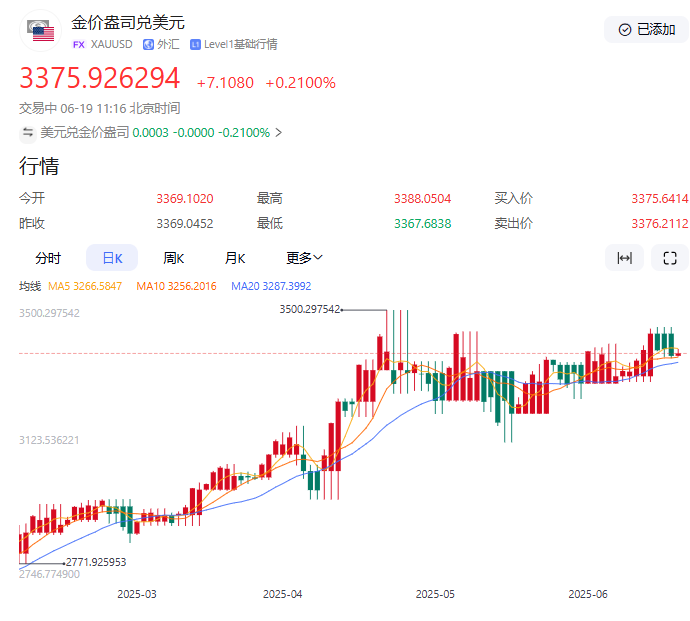
The hawkish stance of the Federal Reserve pushed the US dollar index to rise to 98.85 after the decision, and gold spot prices were suppressed and broke through the oscillation range, hitting a low of $3367.68 per ounce and a high of $3388.05 per ounce, showing a downward trend compared to the previous days. On a technical level, the 1-hour candlestick chart shows that the 5-EMA crosses below the 10 EMA to form a dead cross, the MACD green bar amplifies, and the middle Bollinger Band ($3395) forms strong resistance, establishing a short-term bearish trend.
4、 Expert opinions and market prospects
Nomura Securities Chief Strategist Naka Matsuzawa pointed out that the Federal Reserve’s decision highlights its “inflation first” stance, and gold will face downward pressure in the short term. However, in the medium to long term stagflation environment, gold remains a “core allocation asset”. Goldman Sachs believes that if the September inflation data falls below 2.8%, the Federal Reserve may cut interest rates early, and gold is expected to break through $3400 again in the fourth quarter.
The Federal Reserve has suspended interest rate hikes for five consecutive months, but expectations of rate cuts have significantly cooled due to the risk of tariff inflation. In the short term, hawkish signals and the strengthening of the US dollar are suppressing gold prices, but medium – to long-term stagflation risks, expectations of interest rate cuts, and geopolitical uncertainty still provide support for gold.


 English
  Chinese
  Vietnamese